
How the TikTok algorithm works in 2026, in TikTok's own words
November 5, 2026 · 17 min read
Here is how the TikTok algorithm works, in one paragraph, using TikTok's own documentation as of November 2026. For every viewer, TikTok selects a pool of eligible videos, predicts how likely that person is to interact with each one (finish it, skip it, like it, share it, comment, follow the creator, tap the sound), ranks them by that prediction, removes videos that are too similar to each other, and then applies rules such as including local creators and never recommending content from accounts aged under 16. For most people, what they actually do (including how long they watch) carries more weight than anything about the video's metadata or their device.
That is not our summary of a rumour. It is stitched together from three official sources: TikTok's Support Center page "How TikTok recommends content", the Transparency Center's "Introduction to the TikTok recommendation system" and the Community Guidelines that took effect on September 24, 2026. Where those pages disagree with older material, such as TikTok's well-known 2020 newsroom post, we say so.
This guide walks through each part, then turns it into things you can do: how to read the system's verdict on your videos in TikTok Studio, why a video stalls, what is myth and what is not, and how search works differently from the For You feed. If you want the practical playbook straight away, read how to go viral on TikTok next. This post is the why.
The short version
- There are three groups of signals: user interactions, content information and user information. TikTok says interactions, including time spent watching, are generally weighted most heavily on the For You feed.
- Every candidate video gets a prediction score: an estimate of how likely you are to interact with it.
- The pipeline has five stages: selecting videos, predicting, ranking, a similarity check, and recommendation rules.
- Only videos that pass moderation can be recommended at all. Some content is allowed on TikTok but made ineligible for the For You feed (FYF).
- Search works differently: there, how well a video matches the search term generally matters most.
- TikTok's 2020 explainer said follower count and past hits are not direct factors. The current pages neither repeat nor contradict that.
- TikTok never uses the word "shadowban". It uses "ineligible for the FYF" and shows that status in your analytics and in Account check.
Where this information comes from
TikTok publishes more about its recommender than most platforms, but the material is scattered. The four sources that matter, in order of how current they are:
| Source | Date | What it is good for |
|---|---|---|
| Community Guidelines: For You feed eligibility standards | Released Aug 25, 2026; effective Sep 24, 2026 | What makes content ineligible for the FYF, and that low views do not necessarily mean a rule was broken |
| Support Center: How TikTok recommends content | Undated, live Nov 2026 | The three signal groups, how weights differ between For You, Search and LIVE |
| Transparency Center: Introduction to the recommendation system | Undated, live Nov 2026 | The five-stage pipeline and the list of interactions the system predicts |
| Newsroom: How TikTok recommends videos #ForYou | 2020 | History: follower count not a direct factor, no duplicates, deliberate diversity |
Anything you read elsewhere, including this article, is an interpretation of those pages. Treat confident claims about secret thresholds ("the first 200 viewers", "70% completion or nothing") with suspicion: none of them appear in TikTok's documentation.
The three signal groups
TikTok's Support Center lists three main factors for the For You feed, and states plainly that each can play a larger or smaller role and that their importance changes over time.
- User interactions: content you like, share, comment on, and watch in full or skip, plus accounts of followers you follow back.
- Content information: sounds, hashtags, the number of video views, and the country where the content was published.
- User information: device settings, language preference, location, time zone and day, and device type.
The sentence that matters most for creators is this one: for most users, user interactions, which may include the time spent watching a video, are generally weighted more heavily than the others. In other words, the strongest evidence TikTok has about whether your video should be shown to someone is how people similar to them behaved when they saw it.
The 2020 newsroom post put the same idea in a sharper example: whether a viewer finishes a longer video from beginning to end is a strong signal, while whether the viewer and creator are in the same country is a weak one. Device and account settings get lower weight because people do not actively express them as preferences.
Notice what is not in the list: your follower count, your posting streak, whether you used a trending hashtag in the first hour. Those things can matter indirectly (more followers means more people likely to see and interact early), but they are not inputs TikTok names for the For You feed.
The five-stage pipeline
The Transparency Center describes the system as a sequence. Understanding the order explains a lot of behaviour that creators find mysterious.
TikTok's recommendation pipeline, paraphrased from the Transparency Center
1. SELECTING   Build a pool of candidate videos for this viewer.
              Only videos that passed moderation are in the pool.
2. PREDICTING  Score each candidate: how likely is this person
              to like, share, comment, follow, finish, skip,
              favourite, spend time on it, tap the sound,
              or mark "Not interested"?
3. RANKING     Order candidates by that prediction score.
4. SIMILARITY  If top-ranked videos are too alike (for example the
              same sound), swap some out for others.
5. RULES       Apply rules: include creators from the viewer's
              region; never recommend content from accounts
              aged under 16; avoid repeated exposure to some
              sensitive themes.
Three practical consequences follow. First, if your video is not in the pool, nothing else matters: moderation status comes before quality. Second, the score is about predicted behaviour for a specific viewer, so the same video can be a great recommendation for one person and a poor one for another. Third, the similarity check means that copying the exact sound and format of whatever is trending puts you in direct competition with every other copy for a limited number of slots in a viewer's session.
What the system predicts
The Transparency Center's appendix lists the interactions the model tries to predict. Read it as a list of things your video can earn:
- Like, share, comment on, or mark a video as "Not interested".
- Follow the video's author or interact with their profile.
- Finish, skip, or favourite a video.
- Spend a certain amount of time viewing a video.
- Tap the video's soundtrack.
Two items deserve emphasis. "Skip" and "Not interested" are on the list, so negative signals are modelled explicitly; a video that people swipe away from in the first second is not neutral, it is evidence. And "interact with their profile" means a video that makes people curious about who made it is doing something useful beyond its own view count.
The appendix also lists video-side signals: the time the video was posted, the region it was posted from, the author's language setting, the soundtrack, the length of the video and its hashtags. Posting time being on the list is interesting, but TikTok gives no guidance on how much it weighs; our best time to post on Instagram and TikTok guide covers what the studies found and how to test your own window.
Watch time is the signal TikTok keeps naming
Across its creator material, TikTok returns to watch time more than any other metric. A Creator Academy article on high-quality videos says plainly that watch time is a key driver for the recommendation system. The Support Center lists time spent watching as one of the interactions that are weighted most heavily.
TikTok has also said, in a Creator Academy article about the Creator Rewards Program, that users now spend half their time on TikTok watching longer content and that watch time of videos over a minute had grown five times faster than short videos over a recent six months. Those are TikTok's own marketing figures with no method or date attached, so read them as a statement of direction: TikTok wants longer, watchable videos.
Independent data points the same way. Buffer's analysis of 1.1 million TikToks (March 2025) found videos over 60 seconds got 43.2% more median reach and 63.8% more median watch time than 30 to 60 second videos. Socialinsider's study of about 8 million brand videos (January to June 2026) found engagement rate peaked at 15 to 30 seconds while median views peaked at 2 to 3 minutes. The honest reading: short videos are easier to finish, longer videos accumulate more watch time when they work, and the right length is the shortest one that delivers the whole payoff.
How a new video gets its first viewers
TikTok does not publish a staged rollout with numbers. What it does say is enough to describe the shape. A newly uploaded video goes through automated review first; the 2020 post noted that videos that have just been uploaded or are under review may be ineligible for recommendation until that finishes. Once eligible, it can be selected as a candidate for viewers whose predicted interest is high. The Community Guidelines add that additional review happens if content gains popularity or is reported, and the Support Center says safety teams may review content as it rises in popularity.
That is why some creators notice a pause, then movement, then sometimes a second pause as a video grows. It is not proof of a secret test-and-release ladder with fixed audience sizes. It is consistent with a system that scores, observes behaviour, rescores, and reviews things that get big.
The useful takeaway is simple: the early viewers of a video are mostly strangers chosen because the system predicts they might like it. Your job is to make sure those strangers stay, which is a packaging and storytelling problem, not an algorithm problem. Our hooks for Reels and TikTok guide is about exactly that moment.
Diversity is designed in
TikTok has said since 2020 that it deliberately mixes in videos that do not match your expressed interests, and that this is an intentional part of the design. The current Support Center says TikTok aims to diversify feeds by introducing new creators and content, and that it typically does not recommend content you have already seen.
The 2020 post was more specific: your feed generally will not show two videos in a row made with the same sound or by the same creator, and duplicated content and spam are not recommended. The current Transparency Center describes the similarity check doing exactly this at the ranking stage.
For creators this cuts both ways. It is why a brand new account with no followers can land on a stranger's feed at all. It is also why reposting the same video twice, or making a near copy of someone else's, tends to go nowhere: the system is built to avoid showing people the same thing.
Search works differently from the For You feed
This is one of the most useful and least discussed parts of the documentation. On TikTok Search, content information, including how well a video matches the term someone typed, is generally weighted more heavily than behaviour. Search signals named include how well the content matches the query, hashtags and the sound used.
Creator Academy goes further: Search values relevance over views and engagement, titles and covers should clearly show the topic, and irrelevant text stacking will hurt traffic. It also calls two popular tactics myths: hiding a list of keywords as tiny on-screen text that is swiped off screen (which it says can get a video flagged for spam), and adding a long list of hashtags to rank higher.
So a video can do poorly on the For You feed and still be found for months through search if it answers a specific question clearly. Since 2025 the Creator Rewards Program has also rewarded videos for their search value. We go deep on this in Instagram and TikTok SEO.
LIVE is the one place follower count is named
For the LIVE feed, the Support Center lists the creator's number of followers as part of content information. It is the only feed where TikTok names follower count as an input. If you plan to go LIVE (you need to be 18 and have 1,000 followers), expect your existing audience size to matter there in a way it does not on the For You feed.
What makes a video ineligible for the For You feed
The Community Guidelines effective September 24, 2026 are explicit that the For You feed is meant for a broad audience, from teenagers to great-grandparents, and that some content allowed on TikTok is still made ineligible for it. The categories most relevant to ordinary creators:
- Unoriginal or reused material without anything new. TikTok's originality policy (updated September 26, 2026) lists content copied completely from others, content largely repurposed without creative edits, compilations with little added value, and content with someone else's visible watermark or logo.
- Engagement bait that tries to manipulate people into giving gifts or inflating likes or follows.
- Misinformation that may cause moderate harm, and content temporarily under review by fact-checkers.
- Themes TikTok limits repeated exposure to, such as extreme fitness or dieting, sexual suggestiveness, sadness, or overgeneralised mental health advice.
- Content from accounts aged under 16, which is never recommended.
There is also an account-level rule: if an account that does not break the rules still posts a lot of FYF-ineligible content, TikTok may make the whole account and its content ineligible and harder to find. Ineligible does not mean invisible: people can still find the video through search or your profile, though TikTok says ineligible content may also be made harder to find in search.
The shadowban question, answered honestly
TikTok's official pages do not use the word shadowban. They neither confirm nor deny it in those terms. What they do say is more useful than either answer.
The For You feed standards state that if a video is not getting many views, it does not necessarily mean it broke a rule, and that creators can check analytics to see how videos are performing, including whether any were made ineligible for recommendation. The enforcement page says that if content is made ineligible for the FYF or restricted, that information appears in the TikTok analytics tool, and that you can appeal. And the originality policy has a line worth printing out: if you think your content is original but it still is not getting views, it may be a lack of community engagement rather than ineligibility.
So there are two different situations that both feel like a shadowban. One is a real, visible restriction, which TikTok says it shows you. The other is the far more common case: the system tried the video on some viewers, they did not stay, and it stopped. Research on the subject backs up how easily the two get confused. A Center for Democracy and Technology survey of more than 1,000 US social media users (April 2022) found nearly one in ten believed they had been shadowbanned, while academic work (Delmonaco and colleagues, 2024, 71 surveys and 24 interviews) describes users building and testing "folk theories" to explain drops they cannot see into.
Checklist: when a video seems shadowbanned
1. Open TikTok Studio > More tools > Account check.
   Green check: no issues. Red mark: read what it flags.
   (Also: Settings and privacy > Support > Safety Center
   > Account check.) It scans your last 30 posts.
2. Open the video's analytics. If it was made ineligible
   for recommendation, TikTok says that is shown there.
3. If it is flagged and you think it is wrong: appeal.
4. If nothing is flagged: it is a performance problem.
   Check retention, the first 3 seconds, and traffic
   source before blaming the system.
5. Do not delete and repost the same video. Duplicates
   are not recommended, and the system is built to
   avoid showing people the same thing twice.
Myths the documentation does not support
| Claim you will hear | What TikTok's pages say |
|---|---|
| You need lots of followers to reach the For You feed | The 2020 post says follower count and past high performers are not direct factors (more followers can mean more views indirectly). |
| Stuff keywords as hidden text to rank in search | Creator Academy calls this a myth that can get a video flagged for spam. |
| Use 20 to 30 hashtags | Creator Academy calls long hashtag lists a myth; overloading can work against you. |
| Videos edited in other apps are penalised | Creator Academy says your editing tool will not affect search performance. |
| Labelling AI content kills reach | TikTok says the AI-generated label does not affect distribution if the content follows the guidelines. |
| Joining the Creator Rewards Program lowers reach | Creator Academy says joining will not affect your content's performance. |
| Your account needs warming up before it can post | TikTok publishes nothing about warming up, for or against. See our guide to how to warm up a new TikTok account. |
On the last row, we wrote a whole guide on how to warm up a new TikTok account because the practice is widespread and the honest answer is more nuanced than either "it is essential" or "it is nonsense".
What changed in the United States in 2026
The TikTok USDS Joint Venture was established in early 2026 under the September 25, 2025 executive order. Its announcement says the joint venture will retrain, test and update the content recommendation algorithm on US user data, secured in Oracle's US cloud, and its own site says it manages the recommendation systems in the US app and governs trust and safety there. It also says US creators can still be discovered globally through interoperability.
What we could not find is any official description of user-visible changes to ranking signals after the retraining. Posts claiming the US algorithm "reset" come from third-party blogs. The Support Center and Transparency Center descriptions above are the ones TikTok still publishes, so that is what we work from. If you are a US creator and your numbers moved in 2026, check the boring explanations first (format, length, topic, seasonality) before assuming a new algorithm.
India: TikTok is not available
TikTok has been blocked in India since June 29, 2020, when the Ministry of Electronics and IT banned 59 apps under Section 69A of the IT Act. In August 2025 the government clarified that no order had been issued to lift the ban, and we found no official source saying it was lifted in 2026. India is also absent from the Creator Rewards Program and Creator Search Insights country lists.
If you are a creator in India, the honest advice is not to look for workarounds. TikTok's Creator Code of Conduct prohibits using VPNs to circumvent its systems, and building on a platform you cannot legally use is building on sand. The same principles in this guide (watch time, originality, search relevance) apply to Instagram Reels and YouTube Shorts, both of which pay creators in India through some programs; see Instagram and TikTok monetization.
How to read the algorithm's verdict in TikTok Studio
You cannot see the model, but you can see what it saw. Open your profile, tap the menu, choose TikTok Studio, then Analytics (or use TikTok Studio on the web). Analytics can take one to two days to update; follower activity is shown in your local time zone and everything else in UTC.
| Metric | Where | What it tells you |
|---|---|---|
| Retention rate and the drop-off curve | Post analytics | Where people leave. A cliff in the first seconds is a hook problem; a slow slide is a pacing problem. |
| Average watch time | Post analytics | The plainest version of the signal TikTok weighs most. |
| Watched full video | Post analytics | Finish rate. Compare across videos of similar length, not across lengths. |
| Traffic source | Post analytics | For You versus Search versus profile versus Following. Tells you which system is carrying the video. |
| Search queries | Post analytics | The exact terms that found the video. Gold for titles and future topics. |
| New versus returning viewers | Overview and Viewers tabs | Whether you are reaching strangers or only your existing audience. |
| Most active times | Viewers tab | When your viewers were on TikTok in the last 7 days. |
| Ineligible for recommendation notice | Post analytics, Account check | Whether a restriction, not performance, is the issue. |
TikTok's own older analytics tutorial makes a point worth keeping: no single engagement metric is necessarily more important than another. Look for patterns across five or more videos, not verdicts from one.
Turning the documentation into a working routine
Everything above reduces to a short routine you can run on every video. It is not a hack. It is aligning what you make with what TikTok says it measures.
Per-video routine
BEFORE POSTING
[ ] The video is original: no other app's watermark,
    no re-upload, not a near copy of your own last post.
[ ] The first 3 seconds show the point or the question.
[ ] The topic is clear from the cover, the first line of
    the caption and the spoken words (search relevance).
[ ] 1 to 5 relevant hashtags, not a wall of them.
[ ] Nothing that would make it FYF-ineligible for a broad
    audience (check the categories above).
[ ] Realistic AI elements are labelled.

48 HOURS AFTER
[ ] Retention curve: where is the first big drop?
[ ] Average watch time versus your last 5 videos.
[ ] Traffic source: For You, Search or profile?
[ ] Search queries: any you did not expect?
[ ] Any ineligibility notice? If yes, Account check.

EVERY 10 VIDEOS
[ ] Rank by average watch time and finish rate.
[ ] Make 3 more like the top 2. Drop the format of the
    bottom 3. Change one variable at a time.
What this means for faceless and AI-assisted accounts
Nothing in TikTok's documentation favours a face over no face, or a phone camera over an animation. The signals are about viewer behaviour, originality and relevance. That is good news for faceless explainers, and a warning: TikTok's Creator Rewards Program explicitly lists slide videos, looping videos, single or multiple photos and text-only overlays as not original for rewards, and the For You feed standards exclude unoriginal reused material. A faceless account has to be original in what it says and shows.
On AI: TikTok requires a label on AI-generated or significantly edited content showing realistic scenes or people, may auto-label files that carry C2PA Content Credentials (and that auto label cannot be removed), and says the label does not reduce distribution. Artistic styles, anime and generic text-to-speech narration do not need it. Our guide to starting a faceless TikTok account turns this into a setup.
Kinetic type · 33 s
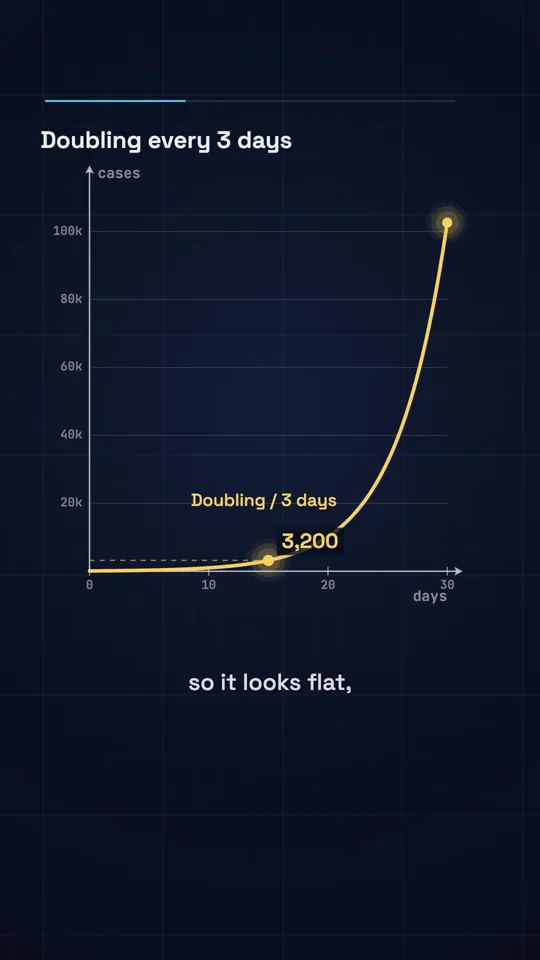
Diagram explainer · 41 s
Where Video Studio fits
The algorithm rewards videos people watch to the end, that are original, and whose topic is obvious. Making those consistently is the hard part. WhatToUpload's Video Studio turns a topic into a finished vertical video for TikTok, Reels or Shorts in about 3 minutes: Claude writes the script, our renderer draws every frame as code, a voice is generated and captions are burned in inside the safe zone. Styles live today are Kinetic type, Ink stickman and Diagram explainer; you can see them on the faceless video generator and Shorts maker pages.
Auto-posting to YouTube is live for testers; Instagram and TikTok posting is coming, so for now you download the MP4 and post it yourself. Plans are $19, $49 and $99 a month, you get 10 free credits at signup (enough to try the script tools, not a full video), and a 30 second video is 26 to 30 credits. If you are aiming for the Creator Rewards Program, remember it only counts videos of at least one minute. It does not guarantee views; nothing does.
Sources and methodology
Platform behaviour comes from Instagram's, TikTok's and YouTube's own documentation and statements, checked in November 2026. Third-party studies are listed with their sample and method, and treated as starting points for your own testing rather than rules. Creator figures from posts on X are the creators' own claims.
- 01TikTok Support Center: How TikTok recommends contentUndated, live Nov 2026. Three signal groups; interactions weighted most on For You; relevance on Search; follower count on LIVE.
- 02TikTok Transparency Center: Introduction to the recommendation systemUndated, live Nov 2026. Five-stage pipeline, similarity check, predicted interactions, under-16 rule.
- 03TikTok Community Guidelines: For You feed eligibility standardsEffective Sep 24, 2026. Broad-audience standard; low views do not necessarily mean a rule was broken.
- 04TikTok Community Guidelines: Integrity and authenticityEffective Sep 24, 2026. Unoriginal content, engagement bait, fake engagement, AI labels.
- 05TikTok Community Guidelines: EnforcementEffective Sep 24, 2026. FYF ineligibility shown in analytics; appeals.
- 06TikTok Newsroom: How TikTok recommends videos #ForYou2020. Follower count not a direct factor; no duplicates; deliberate diversity. Historical.
- 07TikTok Creator Academy: Getting discovered with SearchUpdated Aug 18, 2026. Keyword and hashtag stuffing are myths.
- 08TikTok Creator Academy: Originality policyUpdated Sep 26, 2026. What counts as unoriginal, including watermarks.
- 09TikTok Creator Academy: Account checkUpdated Jun 16, 2026. Scans the last 30 posts.
- 10TikTok Creator Academy: Analytics introductionMetric definitions, traffic source, search queries, most active times.
- 11TikTok USDS Joint Venture announcementEarly 2026. Retraining the US algorithm on US user data.
- 12PIB: Government blocks 59 apps including TikTokJune 29, 2020. India ban.
- 13Buffer: Longer TikToks get more views1.1 million TikToks, March 2025.
- 14Socialinsider: How long are TikTok videos8,000,795 brand videos, Jan to Jun 2026.
- 15Center for Democracy and Technology: Shedding light on shadowbanningSurvey of 1,000+ US users, April 2022.
Frequently asked questions
What does the TikTok algorithm look at most?
For the For You feed, TikTok says user interactions, which may include time spent watching a video, are generally weighted more heavily than content information or user information. It predicts whether each viewer will like, share, comment, follow, finish, skip or spend time on a video.
Does follower count matter on TikTok?
TikTok's 2020 explainer said neither follower count nor past high-performing videos are direct factors in For You recommendations, while noting bigger accounts tend to get more views indirectly. The current pages do not repeat the line. Follower count is named as an input only for the LIVE feed.
Is TikTok shadowban real?
TikTok does not use the word. It does make some content ineligible for the For You feed, says it shows that status in your analytics, offers Account check to scan your last 30 posts, and lets you appeal. It also says low views do not necessarily mean a rule was broken.
How does TikTok search ranking differ from the For You feed?
On Search, how well a video matches the term someone typed is generally weighted most. TikTok says search values relevance over views and engagement, and calls hidden keyword text and long hashtag lists myths.
Did the TikTok algorithm change in the US in 2026?
The TikTok USDS Joint Venture says it is retraining the recommendation algorithm on US user data, secured in Oracle's US cloud. TikTok has not published a description of user-visible ranking changes, so claims of a US reset are unverified.
Why does my TikTok get views then stop?
The most common reason is that early viewers did not stay, so the predicted interest for similar viewers fell. Check the retention curve and traffic source, and run Account check to rule out an eligibility restriction.
Can I use TikTok in India?
No. TikTok has been blocked in India since June 2020 and the government said in August 2025 that no order lifting the ban had been issued. TikTok's Creator Code of Conduct also prohibits using VPNs to get around its systems.